
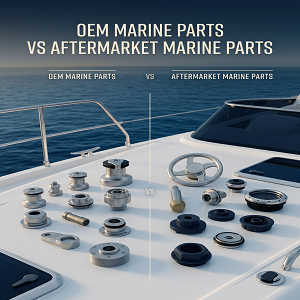
OEM Marine Parts vs Aftermarket Marine Parts: Which Is Right for Your Boat?
When a boat needs a replacement component, many owners ask the same question: should they buy an original part or choose an alternative? The answer depends on the engine or vessel system, the importance of the component, the available evidence, and the total cost of the repair. In this guide to "OEM marine parts vs aftermarket marine parts", we compare the practical differences so boat owners and marine enthusiasts can make a more informed decision.
There is no universal winner. An OEM part may offer a familiar reference and straightforward fitment, while a well-made aftermarket component may provide useful availability or savings. The safest choice is the one that matches the application and comes with enough information to support correct installation.
What Are OEM and Aftermarket Marine Parts?
OEM stands for original equipment manufacturer. OEM marine parts are made by, for, or to the specification associated with the original engine or vessel system. They may include filters, gaskets, water-pump components, sensors, electrical parts, control components, fasteners, and other model-specific items.
Aftermarket marine parts are produced by another company or supplied outside the original brand’s distribution channel. The category includes products designed as direct replacements, broad-application components, private-label items, and specialized alternatives. Quality and fitment can vary between products, so “aftermarket” should not be treated as a single standard.
Compatibility: The Most Important Comparison
Compatibility should come before price. Start with the engine or vessel manufacturer, model, serial number where available, model year, horsepower or system rating, and the original part number. Add photographs of the identification plate and installed component. If the boat has been modified, mention that because the current setup may differ from the original design.
An OEM part can simplify the identification process when service documents and part diagrams use the same number. An aftermarket component may also be suitable, but the supplier should explain the cross-reference or specification match. Do not assume that two products are equivalent because they look alike or share a general description.
Compare technical details, not appearance
Review dimensions, mounting points, thread type, connector design, seal profile, material, finish, flow direction, voltage, pressure, capacity, and included hardware as relevant to the part. A component can fit physically while still having an unsuitable material or operating characteristic.
For fuel and cooling systems, consider fluid, temperature, pressure, and marine-environment requirements. For electrical products, confirm connectors and system compatibility. For control or steering components, check length, attachment points, movement, and adjustment requirements.
Cost: Upfront Price vs Total Repair Cost
Aftermarket parts are often considered because the purchase price may be lower or availability may be better. That can be useful, but the unit price does not tell the whole story. Add shipping, inspection, labor, downtime, return freight, and the cost of ordering a second component if the first one is unsuitable.
OEM parts can cost more, but that additional price may be worthwhile when the part is difficult to identify, hard to access after installation, or connected to several systems. A documented aftermarket part may offer better value for a routine service item that is easy to inspect and replace. The right comparison is total cost and risk, not simply the number on the quotation.
Quality and Materials
OEM sourcing may give buyers a recognized specification and established part-number history. This can make recurring maintenance and fleet inventory easier to manage. However, an OEM label does not remove the need to confirm the exact model application or inspect the shipment.
Aftermarket quality must be assessed product by product. Ask for dimensions, material information, corrosion protection, connector details, package contents, inspection records, and installation guidance where relevant. Broad claims such as “premium,” “marine grade,” or “heavy duty” should be supported by useful technical information.
Warranty, Returns, and Supplier Support
Warranty coverage varies by product and supplier. Ask what the warranty covers, how long it lasts, whether installation must be performed by a qualified technician, and what evidence is required for a claim. A warranty may not cover incorrect application, modification, improper installation, normal wear, or use outside the stated conditions.
Return terms are equally important. Confirm whether a return authorization is required, who pays shipping, how damaged goods are handled, and whether an opened or installed part can be returned. These questions apply to OEM and aftermarket products alike.
Installation and Maintenance Considerations
Before installation, compare the package label, part number, quantity, dimensions, connectors, seals, mounting points, and included hardware with the order confirmation. Keep the packaging and written fitment information until the repair is complete. If the replacement looks different from the original, confirm whether it is a documented revision or alternative before proceeding.
Do not drill holes, cut hoses, bend brackets, change connectors, or substitute hardware to force a close match. Follow the correct service information for preparation, torque, lubrication, sealing, adjustment, wiring, and testing. Work involving fuel, steering, electrical safety, internal engine assemblies, or gearcase components may require a qualified marine technician.
After installation, monitor for leaks, unusual vibration, incorrect movement, warning indications, overheating, or other new symptoms. Record the part number, supplier, installation date, engine or vessel application, and service result. Good records make future comparisons more reliable. If the system behaves differently after the repair, review orientation, seals, connectors, fasteners, adjustments, and related components before concluding that the part itself is defective. A qualified technician should assess unresolved issues.
When OEM Parts May Be the Better Choice
OEM marine parts may be preferable when the component is highly model-specific, the installation is difficult, the consequences of an incorrect part are significant, or the available aftermarket documentation is incomplete. They can also simplify recurring maintenance when a fleet or repair business relies on a consistent part-number system.
OEM does not automatically mean every purchase is better. Confirm the current number, serial coverage, availability, and package contents. An OEM part selected for the wrong configuration is still the wrong part.
OEM sourcing may also be useful when several boats use the same engine family and the owner wants consistent records, repeat ordering, and a familiar service reference. It can simplify communication between the owner, technician, and parts supplier when everyone works from the same documented number. Even then, check whether the part has been superseded and whether the package includes all required seals or hardware. Consistency is valuable only when the application is correct.
When Aftermarket Parts May Be Suitable
Aftermarket marine parts may be suitable when the application is clearly defined, the specification is documented, materials match the operating environment, and the supplier provides fitment and return support. They can be practical for routine maintenance, older applications, products with established cross-references, or situations where an original part is unavailable within the required time.
Use more caution when the component is concealed, difficult to replace, safety-critical, or connected to multiple systems. In those cases, ask for stronger evidence or consult a qualified professional before ordering. A small sample or trial order can be sensible when you are testing a new supplier, planning recurring maintenance, or comparing an aftermarket product with an established reference. Inspect the sample before committing to a larger quantity. Record the approved reference, package contents, and installation result so future orders do not depend on memory. This approach lets boat owners capture the potential value of aftermarket sourcing without treating an unverified substitute as automatically equivalent.
Final Decision Checklist
Before choosing between OEM and aftermarket marine parts, confirm:
1. The engine or vessel model and serial information.
2. The exact original part number or technical reference.
3. Fitment, dimensions, materials, connectors, and package contents.
4. Availability and realistic delivery timing.
5. Total delivered cost, including labor and return risk.
6. Warranty, return, and supplier-support terms.
7. Installation requirements and the need for qualified assistance.
Use the checklist as a decision gate rather than a scoring exercise that hides an important uncertainty. If fitment or a safety-critical specification is still unclear, pause the order and request more information. Compare the complete kit contents, delivery timing, and return process as well as the listed unit price. Consider who will install the component and whether post-installation testing is required. A lower price should not compensate for an unresolved compatibility question.
 Send Email
 Maiolyn