
How to Choose Outboard Replacement Parts for Any Boat Engine
The safest way to buy outboard replacement parts is to identify the engine precisely before comparing brands, prices, or delivery times. Engine brand, model, year, horsepower, serial number, and manufacturer specifications determine whether a water-pump kit, spark plug, propeller, injector, gasket, or electronic component will work correctly. A part that looks similar may have a different connector, shaft length, tooth count, pressure rating, calibration, or material.
This matters because an outboard is a matched system. Fuel delivery affects combustion, the propeller affects engine load, cooling parts protect temperature limits, and lower-unit seals protect gears and bearings. Selecting the right marine outboard parts is therefore both a performance decision and a reliability decision.
This article explains a repeatable process for choosing boat engine parts, with practical checks for common engine categories and replacement situations. It also separates routine service items from parts that may require calibration, special tools, or professional installation. That distinction helps owners spend time and money on a verified repair rather than on repeated trial-and-error purchases.
Start With Complete Engine Identification
Do not begin with a generic search for “outboard motor parts.” Begin with the information that narrows the application to one configuration.
Record the identification details
Write down the following before contacting a dealer or supplier:
- Engine brand or manufacturer
- Exact model code, including suffixes
- Model year or production year
- Rated horsepower
- Serial number or product identification number
- Shaft length and mounting configuration
- Two-stroke or four-stroke design
- Carbureted or fuel-injected system
- Manual, electric, or remote-start arrangement
- Existing component number, if readable
The identification plate is usually the first reference, but it should be checked against the owner's manual and parts catalog. Engines may share a family name while using different components across model years or horsepower versions. A serial-number range can be more useful than a general year because manufacturers sometimes change a part during production.
Why horsepower alone is not enough
Horsepower identifies output class, not complete fitment. Two engines with the same horsepower can have different gear ratios, charging systems, cowling parts, ignition modules, propeller hubs, or water-pump designs. Likewise, a propeller for one shaft and spline arrangement may not fit another engine with the same rated power.
Treat horsepower as one filter, not a final compatibility decision.
Match the Part to the Correct System
Once the engine is identified, classify the part by system. This reduces the chance of comparing unrelated components.
1. Powerhead and fuel parts
Powerhead-related parts include gaskets, thermostats, filters, spark plugs, injectors, carburetor kits, fuel pumps, belts, sensors, and lubrication components. Check the manufacturer’s specification for materials, clearances, heat range, flow rate, pressure, and installation orientation.
Fuel-system compatibility is especially important. A hose must be suitable for marine fuel service and the fuel type used by the engine. A filter must have the correct flow capacity and connection style. An injector must match the engine’s control system and calibration requirements; physical fit does not prove that its flow characteristics are correct.
2. Cooling parts
Cooling assemblies can include the impeller, pump housing, wear plate, key, seals, thermostat, gaskets, pressure-control components, and water tube connections. Some kits are sold as a complete assembly, while others contain only the impeller. Compare the kit contents with the service procedure so that you do not overlook a worn housing or damaged plate.
If an old impeller has broken apart, locate and remove fragments from accessible cooling passages before assuming a new impeller has solved the problem. The exact inspection process depends on the engine, so use the service manual.
3. Lower-unit and propeller parts
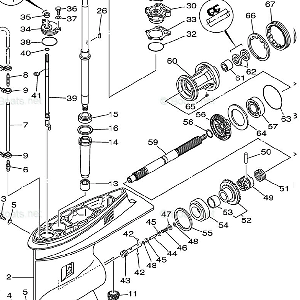
Lower-unit parts include gears, bearings, clutch components, shafts, seals, drain-plug gaskets, and water-pump components. Confirm the gearcase version, shaft dimensions, bearing sizes, and seal locations. Lower-unit work often requires special tools and precise adjustment, making professional installation sensible when internal gears or bearings are involved.
Propellers require a separate fitment check. Confirm rotation, diameter, pitch, blade count, material, hub style, spline pattern, shaft size, thrust washer, and retaining hardware. A propeller can fit the shaft yet load the engine incorrectly. Use the recommended wide-open-throttle range and actual boat loading as part of the selection process.
Use Manufacturer Documentation as the Authority
Online listings can be useful for finding options, but manufacturer documentation should decide whether the part is appropriate. Look for an illustrated parts diagram, application chart, service bulletin, owner’s manual, or official supersession notice.
Compare part numbers carefully
A part number may be replaced by a newer number. That does not automatically mean every older and newer part is interchangeable in every application. Confirm that the manufacturer lists the replacement number for your exact model and serial-number range.
Be cautious with listings that say “fits many models” without showing the model codes or production ranges. A broad claim can hide differences in connectors, gaskets, sensors, gear ratios, or mounting dimensions.
 Send Email
 Maiolyn