
Marine Outboard Parts: A Practical Guide for Boat Owners
Marine outboard parts work together as one compact propulsion system. The powerhead creates combustion, the midsection transfers power and supports cooling and steering systems, and the lower unit turns that power into thrust through the propeller. When one component wears out or is mismatched, the result can be difficult starting, overheating, poor acceleration, gearcase damage, or an engine that cannot deliver its rated performance.
For boat owners, the most useful approach is to understand what each major group of outboard motor parts does, which symptoms point to trouble, and what information is required before ordering a replacement. The engine brand, exact model, model year, horsepower, serial number, and manufacturer specifications all matter. Two engines with similar horsepower may use different water pumps, ignition components, propeller hubs, sensors, or gearcase parts.
This guide explains the main marine outboard parts and provides a practical checklist for maintenance and replacement decisions. It is designed to help with first-pass inspection and informed parts research, not to replace the service manual for a specific engine. When a symptom involves fuel pressure, compression, steering, trim, or internal gears, measured testing and professional assistance may be safer than trial-and-error replacement.
The Main Systems in an Outboard Engine
An outboard is more than a motor. It combines an engine, drivetrain, steering support, cooling system, and mounting structure in one unit. Understanding these systems makes troubleshooting more logical.
The powerhead and internal engine parts
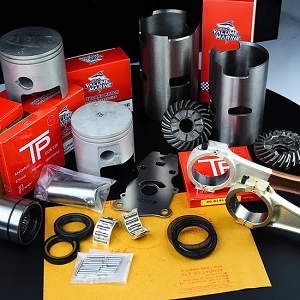
The powerhead contains the engine’s main moving and combustion components. Depending on the design, these boat engine parts may include pistons, piston rings, connecting rods, crankshaft bearings, cylinder heads, gaskets, valves, camshaft components, and an oil pump or oil-injection system.
Two-stroke and four-stroke engines have different service requirements. A two-stroke engine burns a lubricating oil mixture or uses a dedicated oil-injection system, while a four-stroke engine has a crankcase and separate engine oil. Do not use a gasket, lubricant, filter, spark plug, or fuel-system part simply because it fits physically. The part must match the engine’s design and the manufacturer’s specification.
Common signs of powerhead trouble include:
- Uneven idle or repeated stalling
- Loss of compression or a noticeable reduction in power
- Excessive smoke beyond what is normal for the engine type
- Oil or coolant contamination
- Unusual knocking, grinding, or metallic sounds
- Difficulty starting after the engine has been serviced correctly
Internal engine repair should normally follow the service manual. Compression testing, leak-down testing, and electrical diagnosis can help identify the fault before expensive parts are ordered.
Fuel and air-delivery parts
The fuel system supplies a clean, correctly metered fuel charge. Typical marine outboard parts include the fuel tank connection, primer bulb, fuel line, fuel filter, water-separating filter, fuel pump, carburetor or electronic fuel injectors, throttle body, and fuel-pressure regulator where fitted.
Restricted filters, deteriorated fuel lines, blocked carburetor passages, or weak fuel pumps can cause symptoms that resemble ignition failure. A motor may start briefly and die, hesitate during acceleration, or lose power at higher throttle settings. Ethanol-blended fuel can make fuel-quality and storage practices especially important because stale fuel and water contamination can affect hoses, filters, and precision passages.
When inspecting a fuel system, look for soft or cracked hoses, loose clamps, fuel odor, cloudy fuel, water in the filter bowl, and a primer bulb that does not become firm as expected. Relieve pressure and follow fire-safety procedures before disconnecting components on a fuel-injected engine.
Ignition and electrical parts
Ignition parts create and control the spark needed for combustion. Depending on the engine, the system may include spark plugs, plug wires or coil-on-plug units, ignition coils, an electronic control module, a crankshaft or camshaft position sensor, a stator, a trigger, and related wiring or connectors.
Electrical faults are often intermittent. Corrosion at a connector, a damaged ground, or water intrusion can produce a no-start condition that disappears temporarily after the engine dries. Warning signs include weak acceleration, misfiring under load, difficult hot starts, a tachometer that behaves abnormally, or an engine that enters a protective operating mode.
Use the manufacturer’s test procedure and a meter suitable for the circuit. Spark plugs should be selected by the specified heat range, reach, electrode type, and gap. A plug that threads into the cylinder head is not automatically a safe substitute
Cooling, Exhaust, and Midsection Components
The cooling system removes heat from the powerhead and helps protect the engine from thermal damage. The exhaust system routes combustion gases away from the powerhead and, on many outboards, through passages in the midsection and lower unit.
Water pump and thermostat parts
The water pump impeller is a wear item. It uses flexible vanes to move cooling water through the engine. A damaged, hardened, or deformed impeller may reduce water flow. Other related parts include the pump housing, wear plate, key, gaskets, thermostat, pressure-control valve, water tube, and sealing grommets.
- A weak or interrupted telltale stream
- An overheating alarm or warning indicator
- Power reduction after the engine warms up
- Steam or unusually hot water near the discharge area
- An impeller that has broken apart and sent fragments into passages
A telltale stream is useful, but it is not a complete cooling-system test. A clear stream does not prove that every passage is flowing correctly, and a blocked telltale does not always mean the pump has failed. Follow the service manual’s inspection and replacement interval, and replace associated seals when required rather than reusing damaged gaskets.
Mounting, steering, and trim components
The midsection includes structural and control-related parts such as engine mounts, steering brackets, swivel bearings, the steering tube, tilt and trim components, and related fasteners. Hydraulic or electric trim systems may contain a pump, motor, relays, cylinders, seals, and fluid lines.
Excessive play in the steering, clunking during direction changes, slow trim movement, fluid leakage, or an engine that will not hold its trim position deserves prompt attention. Steering and mounting failures can create a direct safety risk, so do not continue operating the boat merely because the engine still starts.
Lower-Unit and Propulsion Parts
The lower unit transfers rotational power through gears and a propeller shaft. Important outboard motor parts include the driveshaft, forward and reverse gears, bearings, clutch dog, shift shaft, propeller shaft, seals, water-pump assembly, drain and fill plugs, and sacrificial anodes.
Gearcase and seal warning signs
Whining, grinding, jumping out of gear, difficulty shifting, metal on the drain-plug magnet, milky gear lubricant, or gear oil leaking from the propeller area can indicate internal wear or water intrusion. A small amount of metal may require professional assessment; it should not be dismissed without checking the manual and service history.
Pressure or vacuum testing of the gearcase can help identify leaking seals. Seal replacement requires the correct tools and careful attention to shaft surfaces. Installing a new seal over a worn or grooved shaft may not solve the leak.
Propellers and hubs
The propeller converts shaft rotation into thrust. Diameter, pitch, blade number, rake, material, and hub design affect acceleration, cruising behavior, engine loading, and handling. A damaged blade can cause vibration and reduce efficiency. A spun or damaged hub may allow the engine to rev without producing expected boat speed.
Choose a propeller using the engine’s recommended operating range, the boat’s load, and the manufacturer’s guidance. The goal is not simply the highest possible top speed. The propeller should allow the engine to operate within its specified wide-open-throttle range when the boat is loaded as intended. Always inspect the propeller shaft, thrust washer, spacer, nut, and cotter or locking hardware as a complete assembly.
 Send Email
 Maiolyn