
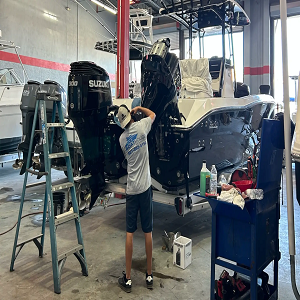
How to Maintain Marine Outboard Parts
A practical maintenance routine should include:
- Flush the cooling system with the correct procedure after operation in salt, brackish, or muddy water.
- Inspect the propeller after grounding or contact with floating objects.
- Check gear lubricant for correct level, appearance, and signs of water contamination.
- Inspect fuel lines, filters, clamps, and connectors for corrosion or deterioration.
- Keep battery terminals clean and verify charging-system connections.
- Grease specified pivot points and propeller-shaft splines with the lubricant recommended by the manufacturer.
- Replace sacrificial anodes when they are substantially consumed or no longer providing adequate protection.
- Follow the service schedule for spark plugs, filters, water-pump components, lubricants, and belts where fitted.
Do not over-grease sealed components, mix incompatible fluids, or use compressed air in ways that can force contamination into sensitive passages. Record the date, engine hours, parts installed, and any measurements. A simple maintenance record makes future diagnosis and parts ordering easier.
Choosing Replacement Parts Correctly
Before purchasing outboard replacement parts, record the following information from the engine identification plate, owner’s manual, or service documentation:
- Manufacturer and engine brand
- Exact model designation
- Model year or production information
- Horsepower and, where relevant, cylinder configuration
- Serial number or identification number
- Long- or short-shaft configuration
- Fuel and ignition system type
- Existing part number and any superseding number
Then compare the candidate part with the manufacturer’s parts catalog and service manual. Confirm dimensions, materials, connector style, spline count, gasket shape, operating temperature, pressure rating, and software or calibration requirements where applicable. For a propeller, confirm shaft diameter, spline pattern, rotation, pitch, and hub compatibility.
OEM parts may be the most direct choice when a safety-critical system, electronic module, specialized seal, or model-specific assembly is involved. Quality aftermarket parts can be suitable when they provide documented compatibility and meet the required specification. The lowest price is not a reliable measure of value if the part causes repeat labor, premature failure, or damage to adjacent components.
Conclusion: Build a Reliable Parts Strategy
Marine outboard parts are interconnected, so good maintenance combines symptom diagnosis, correct specifications, and careful installation. Learn the function of the fuel, ignition, cooling, steering, lower-unit, and propeller systems; inspect wear items on schedule; and verify the engine brand, model, year, horsepower, serial number, compatibility, and manufacturer specifications before ordering.
Create a record for your engine and keep the service manual available whenever you compare outboard replacement parts. For safety-critical repairs or internal gearcase and powerhead work, consult a qualified marine technician. Start with the correct identification details today, then order only boat engine parts that are documented for your exact application. That small preparation step can reduce returns, prevent incompatible installations, and give the technician the information needed to complete a repair efficiently. It also helps you distinguish a scheduled service item from a symptom that needs diagnosis before any purchase. Use that record when speaking with a supplier or technician, and keep the final part number with the engine documents for future reference.
 Send Email
 Maiolyn